Protecting Yourself & Your Property
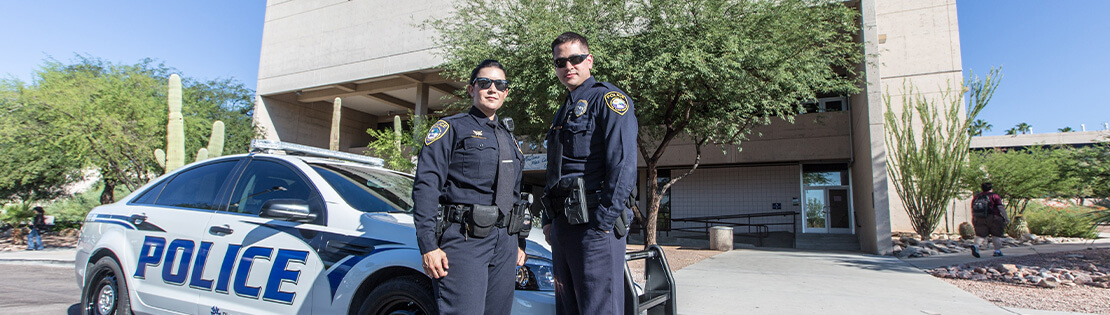
A few precautions and preparations can help keep you safe while on campus property. While the Pima Community College Police Department takes every step to protect the campuses, everyone can play a role in their personal safety.
For a life-threatening emergency: Dial 911
College Police assistance/suspicious activity: 520.206.2700
Never hesitate to call 911 or Pima Police when strangers confront you. Report all criminal activity and losses to Pima Police immediately.
- Avoid dark, vacant places on campus.
- The campuses are well-lit at night. Walk only on lighted sidewalks after dark. Avoid shortcuts.
- Be alert. If you are being followed, head quickly for a lighted area or to a group of people.
- Avoid places where you are vulnerable and there are no exits.
- Employ the "buddy system" when walking to your car at night or traveling to other points in the area. On campus, you can call 520.206.2700 for a Campus Safety escort.
- Give your car a quick "once-over" before entering, with a critical eye for possible break-ins or for persons in the rear seat or floor area.
Report any suspicious activity or misconduct to PCC Police.
Sexual Violence
Pima Community College (PCC) addresses Sexual Violence—which encompasses sexual assault (including rape and fondling), domestic violence, dating violence, and stalking—in its Annual Security Report (ASR).
Below is a detailed summary of the College's policy context, institutional responsibilities, and specific educational/training opportunities available to students and employees.
Institutional Policy & Response Overview
- Definition & Policy Statement: Sexual violence is defined as any unwanted sexual contact or attention achieved by force, threats, coercion, manipulation, pressure, tricks, or violence. PCC maintains an environment aimed at precluding sexual violence, encouraging reporting, and fully complying with the Jeanne Clery Act and the Violence Against Women Reauthorization Act (VAWA).
- Reporting Options: Incidents can be reported directly to the Pima Community College Police Department (PCCPD) for criminal investigation or to the Title IX Coordinator for institutional investigation and administrative sanctions under the Student Code of Conduct or Employee procedures. Confidential reporting options are also available.
- Supportive & Interim Measures: Upon receiving a report, the College provides written notification of victim rights, offering interim protective measures regardless of whether law enforcement is involved. These include campus no-trespass orders, directives, and reasonable accommodations for academic, living, transportation, and working conditions.
Training and Educational Opportunities
The Annual Security Report outlines various strategies, workshops, and awareness campaigns designed to educate the campus community on preventing sexual offenses, recognizing risks, and taking action.
1. In-Person & Orientation Training Programs
- New Student Orientation (Campus Safety): Year-round, monthly, and on-demand presentations covering security procedures, the Annual Security Report, emergency text alerts, and PCCPD services.
- International Student Orientation: Covers campus safety, role of campus police, alcohol/drug awareness, sex, and dating dynamics.
- Bystander Intervention Training: Educational sessions on how to be an active bystander, offering actionable techniques to intervene safely when witnessing potential sexual violence, harassment, or unsafe situations.
- Healthy Relationship Workshops: Educational workshops focusing on identifying healthy versus unhealthy relationship behaviors, preventing dating/domestic violence, and promoting clear boundaries and consent.
2. Web-Based Continuing Awareness Programs (Employee Development System)
PCC provides online courses and modules for continuing education across the campus community:
- Title IX for Higher Education: Comprehensive web-based training on rights, reporting obligations, and preventing sexual harassment and violence in higher education.
- Harassment & Equity Shorts: Modules covering protections against discrimination/harassment (including LGBTQ+ protections), elements of unlawful harassment, and maintaining a harassment-free campus.
- Bullying and Hazing Awareness: Educational online components addressing peer pressure, intimidation, and prevention.
3. Administrative Roles in Educational Delivery
To ensure comprehensive reach across all campuses, several college divisions share key operational responsibilities:
- Campus Vice Presidents & Student Affairs: Responsible for scheduling, conducting, and promoting sexual violence prevention workshops for students and staff on each campus. They also ensure academic success counselors receive specialized training in sexual violence counseling.
- Human Resources: Coordinates and conducts mandatory and optional employee workshops covering how to receive reports of sexual violence, reporting obligations to PCCPD/Title IX, and referring victims to appropriate resources.
- PCCPD (Department of Public Safety): Provides subject-matter expertise for educational workshops, acquires and distributes cost-free prevention materials, and publishes bi-annual awareness articles in the student newspaper (Pima Post) during the Fall and Spring semesters.
All personal property:
- Purses, briefcases, etc., should never be left unattended. Take such items with you if you are leaving the office, classroom, or library study area for any length of time.
- Try not to carry large amounts of cash on your person, or display large amounts of money.
- Make a record of the serial numbers of personal property.
- Maintain a record of your personal credit cards and other valuables in your wallet.
- Keep your auto locked. Never leave the keys in the ignition, and avoid leaving property visible on the seats; store it in the trunk instead.
- Lock your bike to a bicycle rack using a high-quality, U-shaped lock.
- Write your name and ID number in several places in your textbooks to deter thieves who might attempt to resell them.
- Do not leave your textbooks, calculators, or book bags unattended in study rooms, hallways, libraries, cafeterias, or unsecured lockers. Record the serial numbers of calculators and computers.
- Thieves know where students leave their belongings unattended and watch for opportunities to take your property. Be suspicious of people hanging around storage areas, i.e., outside of bookstores, with no apparent purpose.
Faculty and staff:
- When leaving your office or room for the day, make sure:
- All windows are closed and locked.
- All valuable items are removed from the top of desks (radios, clocks, pens, etc.).
- All desks and files are locked.
- All doors are closed and locked.
- Make a record of the serial numbers of college property.
- Never loan equipment, keys, or cards to strangers.
- Require identification and authorization from any "repair person" wanting to remove a computer or other office equipment from the room.
If you see someone suspicious or you discover that you have been victimized, contact the Pima Community College Police Department at 520.206.2700.